
The MUseQ® framework evolves from the reality that it is the same economic entities that drive the strength of both corporate and municipal credits.
State and local governments derive the revenues which secure their bond transactions primarily from taxes, fees, and charges paid by corporations and individuals operating and residing within their jurisdictions.
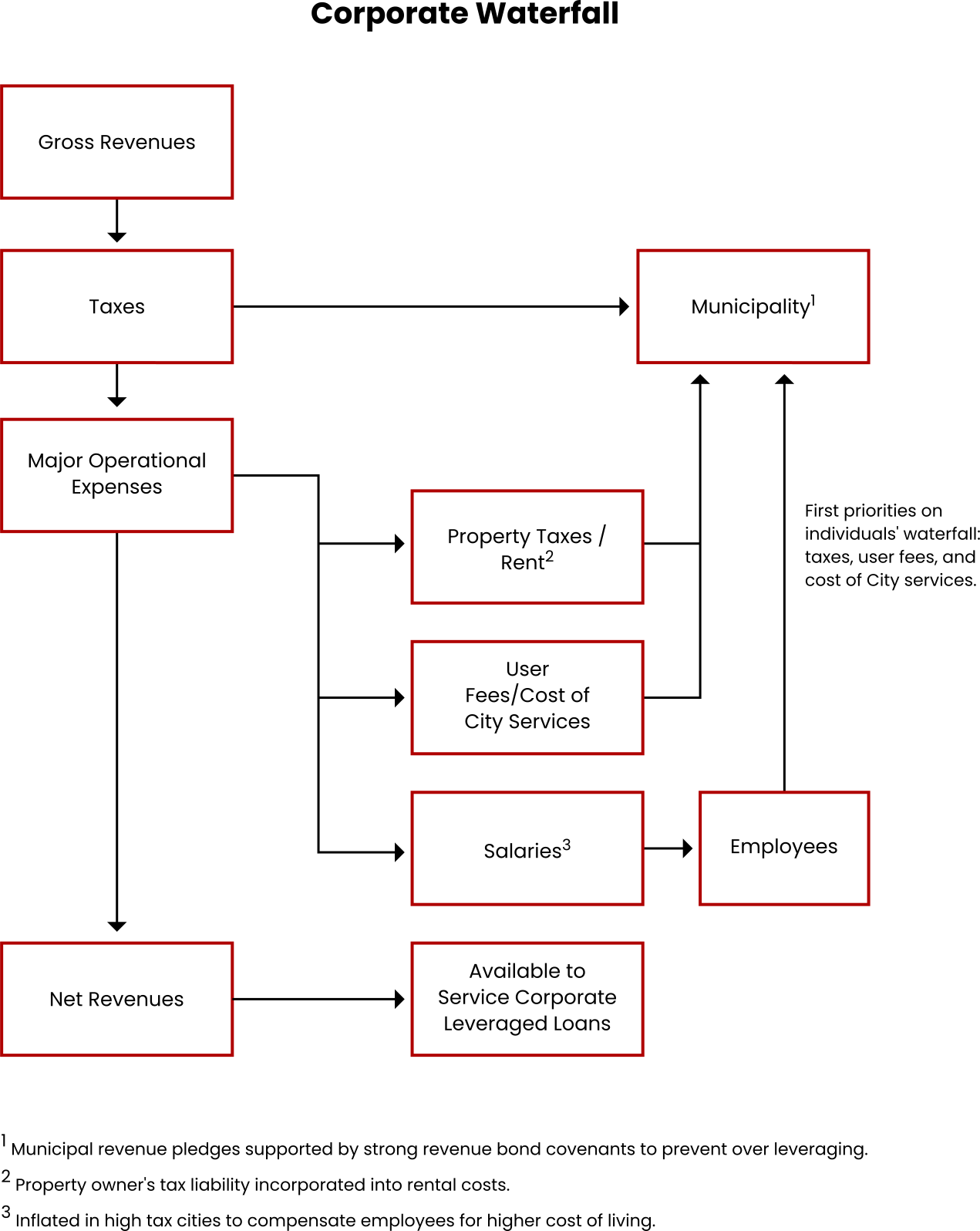
In this regard, municipalities have a senior claim to the revenues generated by these economic entities in that a corporation cannot pay a dollar of debt service to even their most senior bondholders until they pay the taxes and fees owed to the jurisdictions within which they operate.


Likewise, for example, individual property owners cannot pay their mortgages without first paying their property taxes. Similarly, in localities that impose income taxes, these taxes are typically automatically removed from worker’s paychecks.
Put another way, the obligation to repay the corporate bonds used to securitize transactions such as Collateralized Loan Obligations (“CLOs”), no matter how senior those bonds are in the corporation’s debt stack, is a subordinated obligation relative to the corporation’s obligation to pay taxes, fees, and other municipal expenses.
The MUseQ® analytical framework re-evaluates the default probability of municipal credits in the context of corporations’ and individuals’ fully constituted cash flow “waterfalls”, which are representations of the priority within which revenues of the economic entity are allocated.
Table 1 below, for instance, sets forth a typical corporate waterfall
By reconstituting the cash flow waterfalls of the economic entities that drive the credit strength of both corporate and municipal asset classes, MUseQ® unifies credit analysis across both asset classes.
Under current rating agency processes, the top half of the waterfall, anything above the payment to corporate bond holders, is essentially lopped off and divorced from the bottom half and the credit analysis used to evaluate each asset class is performed within the vacuum of their own disassociated metrics.
MUseQ® takes a more organic and integral approach that recognizes this separation as artificial, arising within a capital market system where asset classes evolved in discontinuous fashion and where credit analysis adhered to processes where, as each different asset class materialized, new sets of metrics were developed to evaluate default risk without considering in a meaningful way whether those metrics were consistent with established metrics governing existing asset classes.


Reconstituting the waterfalls of the economic entities that drive credit strength across both corporate and municipal asset classes reveals how we can compare relative default risk in a broader, more connected context and consider whether it is possible, using existing rating agency metrics, that certain highly rated tranches of corporate bond securitizations could continue to perform in an environment where lower rated municipal credits were in default.
Securitized transactions such as CLOs benefit from rating processes that grant them the ability to generate what is known as “credit arbitrage.” CLOs are collateralized by pools of corporate bonds the varied ratings of which are converted by the rating agencies into what is commonly referred to as the collateral pools “weighted average rating factor” (“WARF”) which is a measure of the weighted average rating of the collateral pool.
The WARF for typical CLO transactions has the equivalent average letter rating in the single B category meaning that such a securitization is collateralized by a pool of non-investment grade “junk” bonds.
Take, for example, the calculations set forth in the table below:
Sample Collateralized Loan Obligation ("CLO") ¹
Calculation of Collateralized Loan Obligation Arbitrage Quotient ("CLOAQ")
| CLO Blended Rating | ||||
|---|---|---|---|---|
| Rating | Par Amount (millions) | Percent Distribution | Rating Points | Weighted Rating Points |
| AAA | 259 | 64.484% | 100 | 64.48 |
| AA | 44 | 10.955% | 90 | 9.86 |
| A | 24 | 5.975% | 75 | 4.48 |
| BBB- | 18 | 4.482% | 55 | 2.46 |
| BB- | 20.8 | 5.179% | 40 | 2.07 |
| NR | 35.85 | 8.926% | 0 | - |
| 401.65 | 100.000% | 83.36 | ||
| CLO Blended Rating Points (Approximately AA-) | 83.36 | |||
| Collateral Pool Blended Rating (WARF) | ||||
| BBB- | 1% | 55 | 0.55 | |
| BB+ | 2% | 45 | 0.90 | |
| BB | 6% | 45 | 2.70 | |
| BB- | 7% | 40 | 2.80 | |
| B+ | 15% | 35 | 5.25 | |
| B | 45% | 30 | 13.50 | |
| B- | 24% | 25 | 6.00 | |
| 100% | 31.70 | |||
| CLO Blended Rating Points (Approximately B) | 31.7 | |||
| CLOAQ: | 2.629688811 | |||
| ¹ All data presented taken from an actual, publically rated CLO transaction. | ||||
The table demonstrates the calculation of what we refer to as the CLO Arbitrage Quotient (“CLOAQ”) which is the ratio between the blended rating value of the collateral used to secure the CLO and the blended rating value of the CLO Notes secured by that collateral and sold to investors.
As can be seen, the WARF of the collateral pool using the numerical scale set forth above approximately translates to a “B” letter rating which is deep into the junk category.
The blended rating value of the CLO Notes collateralized by this pool of junk bonds that were sold to investors however approximates a letter rating of “AA-“ which results in a CLOAQ, equal to the ratio of the blended CLO Note rating to the collateral pools WARF, of 2.63x.
It is this “credit arbitrage”; that is, the ability of CLO managers to acquire corporate bonds at prices relating to a blended single B rating level, pool them together and securitize them within the CLO architecture, and then offer multiple tranches to investors at a much higher blended rating level, that drives the creation of what is now over a trillion dollar market.

It is important to point out here that this significant lift in blended rating and market value is generated only as a result of incorporating the collateral cash flows within the CLO architecture. There are typically no added credit facilities within the CLO that impacts in any way the default probabilities associated with the underlying collateral.
As embodied in the metrics governing the rating of this asset class, the general analytical justification for this significant credit lift derives from several core ratings factors including i) over-collateralization of the senior securitized tranches, ii) the diversity across industry sectors inhered in the collateral pool (with broader sector representation reducing risk), ii) the concentration risk incorporated into each industry sector (with less concentration among the corporations reducing risk), and the probability of asset recovery in the case of default.
MUseQ® does not challenge the validity of the rating metrics that facilitate the credit arbitrage granted corporate bond securitizations. Rather, given the realities governing municipal credits, MUseQ® reveals why the relative credit strength of municipal issuers should also benefit from such metrics.
MUseQ® applies the same credit arbitrage metrics in ways that are integral to and consistent with the realities governing municipal credits and in the context of the cash flow priorities set forth in the reintegrated cash flow waterfalls discussed above in order to generate the MUseQ™ Metrics Ratio (“MMR”).
The table below compares the performance of a sample, diversified municipal revenue bond issuer to a typical CLO across the key rating metrics that drive CLO credit arbitrage:
Evaluation of Relative Credit Strength
Sample Calculation of MUseQ® Metrics Ratio
| Rating | Core Metric | Typical CLO | Sample Revenue Bond Issuer | |
|---|---|---|---|---|
| Metric 1 | Collateral Rating | 30 | 70 | |
| Metric 2 | Sector Concentration Risk | 75 | 80 | |
| Metric 3 | Concentration Risk within Sectors | 80 | 90 | |
| Metric 4 | Recovery | 70 | 95 | |
| Metric 5 | Misc - essentiality - 3rd party support - elasticity: Liquidity | 50 | 100 | |
| 76.25 | 108.75 | |||
| MUseQ® Metrics Ratio | 1.426229508 | |||
As demonstrated in the table, the sample revenue bond issuer’s MMR is 1.426x meaning that according to the rating agencies own valuation protocols, the sample revenue bond issuer’s underlying credit profile is significantly superior across all relevant ratings metrics.
The chart below depicts these metrics in terms of the unified cash flow waterfall discussed above.

Using objective, consistent, and transparent probabilistic and correlative analyses, the MUseQ® analytical process then converts the MMR into comparable levels of default probability which reveals that significant numbers of municipal credits have lower relative default risk than billions worth of securitized credits that have achieved superior ratings.
For this and over reasons it is important, at this critical time when the world is facing historical environmental and social challenges, that municipal issuers no longer rely solely on rating agency processes and the narrow interests that govern them to control their capital market destinies.
Current rating agency practices work to reinforce the false psychology that pervades across the capital markets that municipal credits are inherently weaker than corporate structured credits. This reduces capital market opportunities and increases the cost of borrowing for the municipal issuer.
MUseQ® provides an additional, independent valuation of relative credit strength in defense of the municipal issuer.
Such an additional valuation can have significant value as municipal issuers throughout the United States increase their use of taxable bonds and seek new investors at a time of growing instability across the global capital markets; investors who, not being experienced in the strength and resiliency of municipal credits, are left to rely on their relative ratings to make pricing decisions.

If you are a municipal issuer interested in exploring how a MUseQ® valuation can draw more ESG/social impact driven capital at better prices to your bond offerings, or an investor holding municipal credits seeking opportunities to increase their value, or a CLO investor looking for opportunities to either increase your social impact investments or are interested in exploring a new generation of securitizations collateralized by municipal credits (see here), or an emerging nation sovereign debt issuer who wants to explore how beneficial structuring and credit evaluation protocols routinely deployed within other asset classes can increase the stability of your nation’s debt , we invite you to engage with us as we work to evolve the global capital markets in more balanced and sustainable ways.
Please contact us for further information.